
Did you know that Germany only has about 102 fully school-holiday-free workdays in 2026?
Germany has 261 weekdays in 2026. But because school holidays are set by 16 different federal states, only around 102 of those weekdays fall into periods where no German state is on school break.
That is roughly 39% of the year. And this does not even include public holidays or bridge days.
For people outside Germany, this may sound like a small scheduling issue. But if you run a business that depends on events, workshops, customer projects or international business trips, it quickly becomes a structural problem.
I noticed it again while trying to find a date for our next Silicon Valley Innovation Journey.
At first, it sounds simple: pick a week, check availability, invite participants.
But in Germany, there is always another layer. One state is already on summer break. Another one starts two weeks later. Bavaria often comes last. Then come autumn holidays, Christmas holidays, winter holidays, Easter holidays, Pentecost holidays — all slightly different depending on the state.
So the real question is not: How many working days does Germany have?
The real question is: How many days are actually easy to plan across the whole country?
And the answer is surprisingly low.
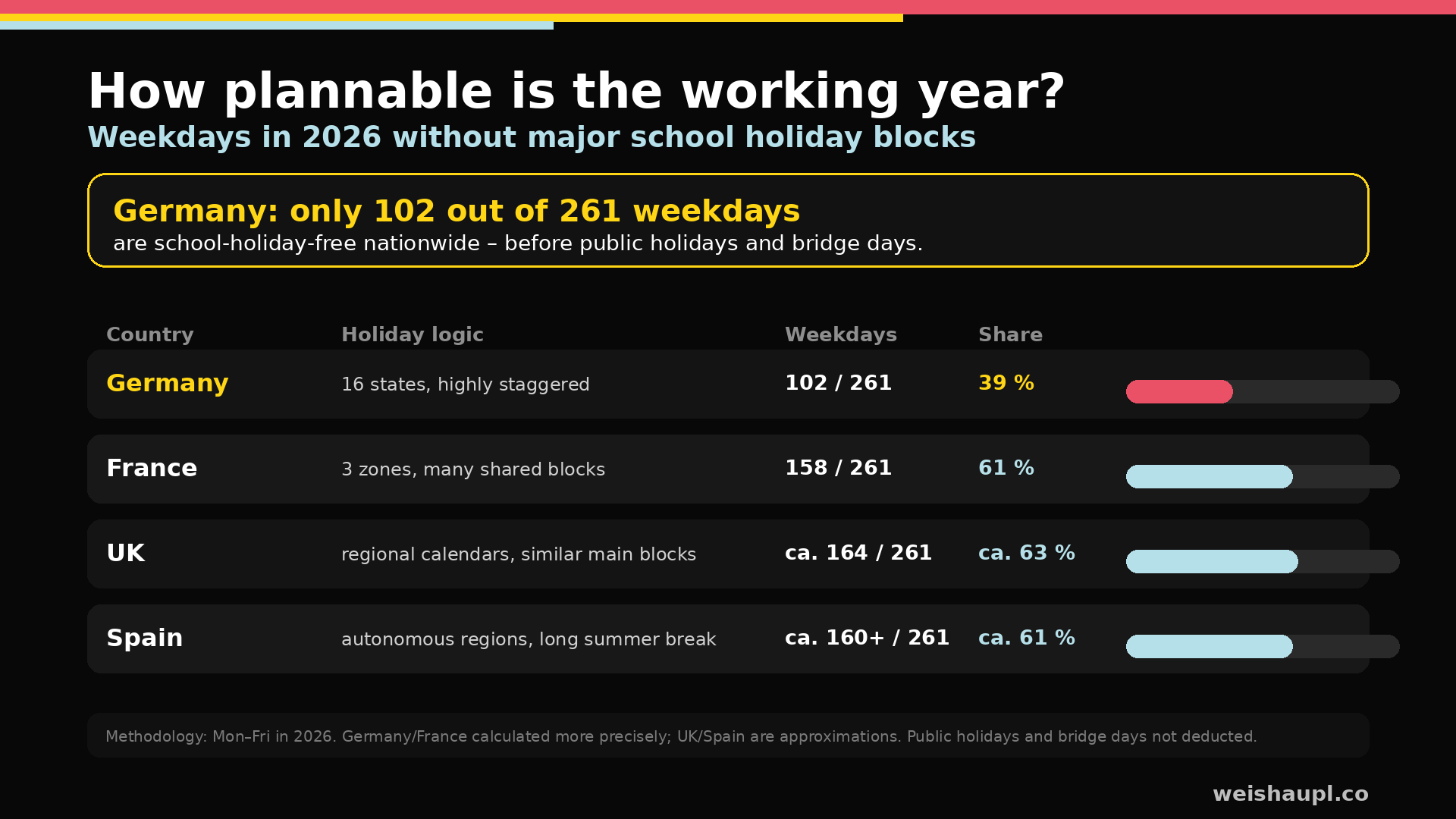
A fragmented working year
Germany already has generous vacation norms compared with many other countries. A full-time employee is legally entitled to at least 20 vacation days per year, and many employees receive 25 to 30 days. On top of that, Germany has public holidays, some nationwide and some regional. Then add 16 different school holiday calendars.
The result is not one big break. It is a fragmented working year.
That fragmentation creates hidden costs: delayed decisions, compressed event seasons, overloaded project windows, difficult travel planning and weeks where key people are not available at the same time.
We talk about productivity — but never about the calendar
What surprises me most is that Germany talks a lot about productivity.
We discuss bureaucracy. We discuss digitalization. We discuss AI. We discuss skilled labor shortages. We even discuss whether one or two public holidays could be cut.
But almost nobody talks about the calendar itself.
Maybe the issue is not that Germans have too much time off. Maybe the issue is that Germany coordinates its available working time badly.
Imagine what could happen if the country did not reduce holidays, but simply planned them better:
More stable project rhythms. Less pressure in peak weeks. Better national event planning. More predictable customer availability. More room for innovation trips, workshops and transformation projects.
Germany does not necessarily need fewer holidays. Germany needs a better operating system for its working year.
Germany: KMK School Holiday Calendar 2025/26 | KMK School Holiday Calendar 2026/27 | KMK Holiday Regulations
France: Service-Public – School Holiday Calendar by Zone A, B, C
UK: GOV.UK – School term and holiday dates (Note: Dates vary by Local Council; examples: Southampton, Norfolk)
Spain: Official calendars by autonomous community (regional variation)
Shaping the future — not just managing it
How Germany, and organizations everywhere, can become more productive and future-ready is one of my core topics — in keynotes, workshops and on our Silicon Valley Innovation Journeys with FUTURE CANDY. If you'd like to bring this conversation to your stage or your company, let's talk.