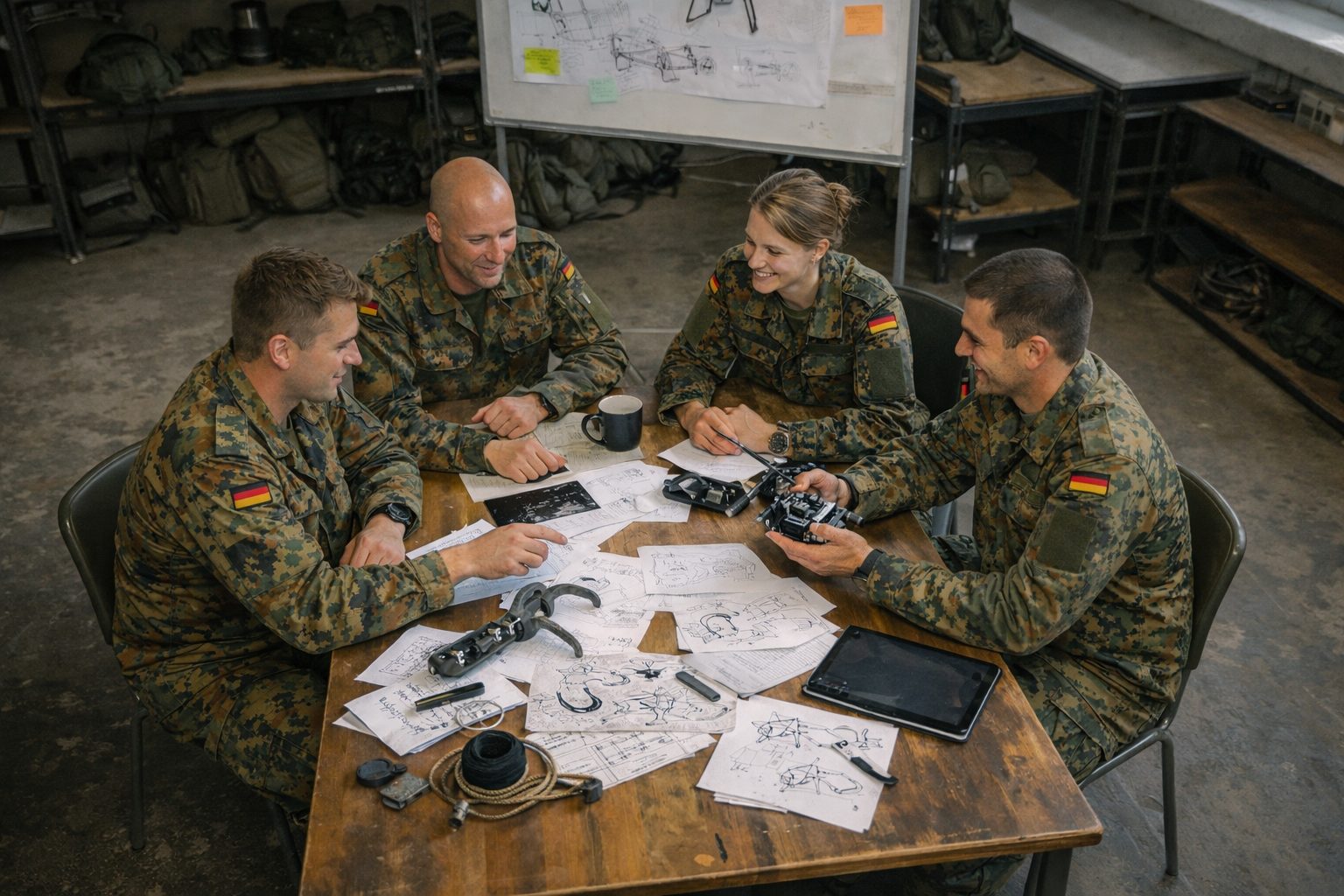
A few weeks ago, I found myself in a room with four soldiers. They were sitting around a table, discussing their current projects. In front of them were sketches, notes, and early prototypes. The conversation moved naturally between topics: new approaches to drone surveillance, several improvements to daily operations, and a grappling hook system designed to simplify certain tasks. One of them mentioned a local blacksmith who had helped redesign the hook. Another gave an update on the drone project. What struck me was not the content itself, but the setting. This wasn't an official innovation workshop, no offsite, no structured format. It was simply a conversation about problems — and how to solve them.
Rethinking Where Innovation Actually Happens
In most organizations, innovation is something we try to organize. We build innovation labs, launch transformation programs, and create dedicated teams to work on future topics. While these approaches can be valuable, they often create a distance from where real problems actually occur. The people dealing with systems, processes, and inefficiencies every day are rarely part of these environments — even though they understand the challenges best.
Innovation cannot be centrally planned. But organizations can create the conditions in which it emerges.
From Control to Empowerment
This is where an idea we are currently working on with the Bundeswehr becomes particularly relevant. As a framework partner, we are supporting the development of so-called Spark Cells — small, decentralized innovation units embedded directly within operational teams. The concept, originally developed in the U.S. Air Force through the AFWERX program, aims to strengthen innovation capabilities where work actually happens. What makes this approach interesting is not just the structure, but what it enables. Instead of centralizing innovation, Spark Cells create a space in which people can identify problems, develop ideas, and test solutions in their everyday environment.
Innovation does not scale through structure alone. It scales through people who take ownership.
Unlocking the People Inside the System
In almost every organization, there is a significant and often overlooked resource: people who question how things work, who see inefficiencies, and who have ideas for improvement. Yet in day-to-day operations, these ideas rarely turn into action. Spark Cells change that dynamic. They create an environment where people don't just report problems — they start solving them. Employees become part-time intrapreneurs.
Most organizations don't lack ideas. They lack the conditions for people to act on them.
Culture Follows Structure
Many organizations talk about transformation, agility, or entrepreneurial thinking. But culture rarely changes through programs or communication alone. It changes when structures enable people to behave differently. Spark Cells provide such a structure.
Culture is not what organizations say. It is what people are able to do.
Innovation That Continues
The grappling hook system went through several test runs and is now in daily use. The drone project secured funding, and the first test flight is about to take place. And most importantly, the conversation didn't stop. Innovation did not end with a project. It continued.
A Lesson for Organizations
The real question might not be how to organize innovation, but how to create the conditions for people to solve problems themselves.
Innovation is not a function. It is a behavior.
Because sometimes it begins when organizations start trusting their own people again.