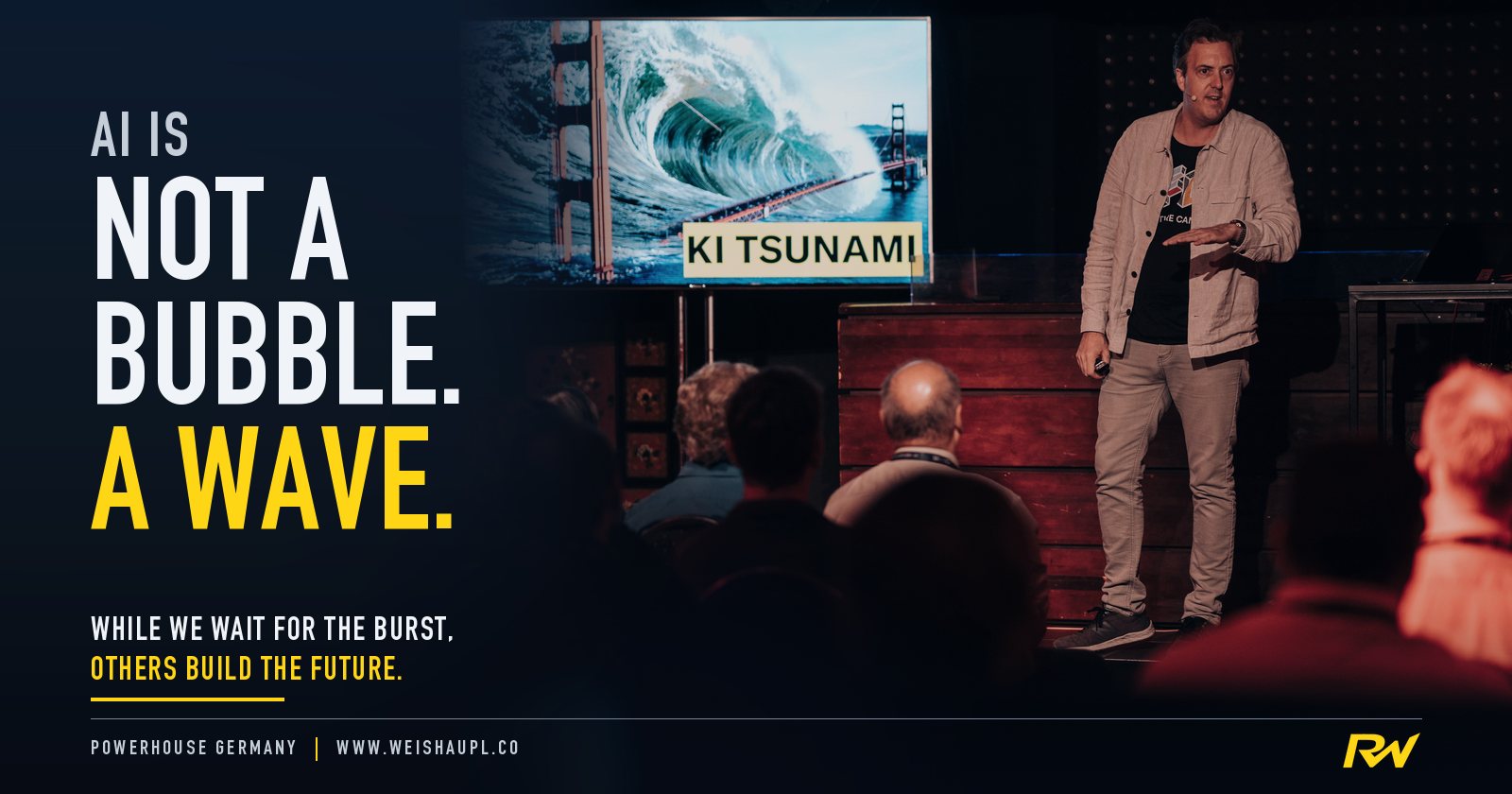
Today, November 19, Anthropic goes public. Raising around $107 billion, it is the largest IPO to date (German source), valuing the company at around $1.5 trillion. And once again, many people seem to be waiting for it not to work out.
I can already see how this will go. Naturally, the share price will rise at first. Then things will level off as many investors take their profits. And as soon as the price goes down, everyone will be pleased again.
We know the pattern. Just in early November, Nvidia lost billions in market value. Shares of the big tech companies came under pressure. After the US midterm elections, concerns about stricter regulation of the AI industry grew. And on top of that came the headlines about the alleged espionage affair surrounding Nvidia CEO Jensen Huang.
And how did the German media landscape respond? With the same old question: Is the AI bubble finally bursting? Is the AI boom already over?
A few examples from early November (all in German):
- HandelsblattAbsturz der Tech-Aktien: Platzt nun eine KI-Blase?Tech stocks crash: Is an AI bubble bursting now?
- TagesschauIst der KI-Boom jetzt zu Ende?Is the AI boom over now?
- WEB.DEWarum KI-Aktien in den Keller rauschenWhy AI stocks are plunging
- TagesschauSpionage-Vorwürfe: Nvidia-Affäre lässt Aktie einbrechenEspionage allegations: Nvidia affair sends the stock tumbling
Honestly? I can't stand that question anymore.
Not because I believe every AI company will succeed. Not because I think current stock market valuations are fundamentally justified. And not because I believe progress will come without setbacks. Of course companies will fail. Of course investors will lose money. Of course there will be exaggerations, corrections and market shake-outs.
But concluding from this that the technology will eventually just disappear again is a massive fallacy.
“The AI bubble won't burst. AI is here to stay. And it will fundamentally change our economy, our companies and our everyday lives.”
A déjà vu that has followed me since 2012
When I moved to Silicon Valley in 2012, the question of when the bubble would burst was already a constant. Back then it was about social media. Facebook and other platforms were seen as hype. How long could this go on? When would the social media bubble burst?
Today, billions of people use social networks. Facebook, Instagram and TikTok are global platforms, business models and communication channels. They have transformed entire industries. Of course companies failed back then, too. But the technology and the user behavior behind it are here to stay.
Then came the sharing economy. Uber, Airbnb and many other companies were eyed with suspicion. Here, too, people kept asking when the bubble would burst. Today these platforms are an established part of the global economy. Not every company from that era survived. But the idea of making existing resources accessible through digital platforms has prevailed.
And then there was Tesla. When the company began to seriously challenge the automotive industry, people debated for years whether the business model could work at all. Whether Tesla would ever turn a profit. Whether it was all just overvalued hype. Still, the established car industry had to come to terms with a new reality: electric mobility, software, digital customer experiences and a different idea of how a car can be developed and operated.
Of course, not every prediction back then was wrong. And of course, not every one of these companies lived up to expectations. But that's not the point.
The point is: We keep debating the possible end of a technology while others have long since started shaping the future with it.
The German appetite for a burst bubble
What I find particularly irritating is how quickly falling share prices turn into a fundamental questioning of an entire technology.
Nvidia loses market value? Is the AI bubble bursting? Tech stocks under pressure? Is the AI boom over?
Sometimes I get the impression that there's more behind these questions than journalistic curiosity. There almost seems to be a certain relief when the big tech companies run into trouble. As if we were secretly pleased that the others might not be doing so well after all. As if it proved that our own skepticism had been right from the start.
I call it a typically German envy debate.
In many of the big technological developments, we're no longer playing in the top league. And instead of asking ourselves how we get back there, we're remarkably keen on dwelling on the potential problems of those who are.
When the Americans invest billions in AI, we ask whether it will ever pay off. When Nvidia grows, we debate whether it's overvalued. When new platforms emerge, we look for the risks. And when share prices fall, the schadenfreude is sometimes almost palpable.
But what exactly do we gain from that?
Not a single German AI company gets any better. No new product is created. No robot gets developed. No factory becomes more productive. And no German entrepreneur wins a single customer.
“We can't seriously hope that other people's future fails just because we're not currently involved in shaping it.”
A burst stock market bubble is not the end of a technology
Of course there have been technology bubbles. The dot-com bubble is the best example. In the early 2000s, the valuations of countless internet companies collapsed. Many firms disappeared, investors lost enormous sums and business models turned out to be unsustainable.
But what actually happened to the internet?
It didn't disappear. It prevailed. It became the foundation for new industries, business models and companies. Amazon survived. Google was founded during that time. And many of today's most valuable companies in the world would hardly be conceivable without it.
“The stock market bubble burst. The technological revolution carried on.”
This is exactly the distinction I miss in many of today's discussions. An overvalued stock is not proof of an overvalued technology. A failed company is not proof of a failed business model. And a market correction doesn't mean we go back to the way things were yesterday.
Perhaps in a few years we'll look back at some of today's AI valuations and wonder how investors could put so much money into certain companies. Perhaps some of today's AI startups will have disappeared. Perhaps the winners will be entirely different companies from the ones we expect today.
But none of that changes the fundamental direction.
AI will be built into software, machines, products and production processes. It will change workflows, enable new business models and change the way we develop products. Robotics will keep advancing. Machines will become more intelligent, more autonomous and more connected.
That can't be turned back just because a stock falls or a business model doesn't work.
Germany can do more. Much more.
And this is where it really gets interesting for me.
Because I don't believe Germany has been written off technologically. Quite the opposite. We have outstanding engineers, developers, scientists, entrepreneurs and an industrial base that many countries envy. We have a long tradition of solving technical problems, building machines and developing complex systems.
The German spirit of engineering hasn't disappeared.
But sometimes I feel we've forgotten to use it.
We've become excellent at analyzing new technologies, discussing risks, setting rules and talking about everything that could go wrong. All of that has its place. Security, data protection and the responsible use of technology matter. But they must not become a substitute for ambitions of our own.
We need to build more again. Try more. Found more. Develop more. We shouldn't just buy and apply AI, but turn it into products and business models of our own. We shouldn't just marvel at robotics at trade fairs, but bring it into our factories. And we need to give our companies the freedom to test new paths instead of first sending every idea through endless rounds of alignment.
That takes courage. The courage not to wait for perfect conditions. The courage to make mistakes. The courage to sometimes build something that might not work. Because that is exactly where innovation comes from.
And perhaps we also need to relearn how to see technological developments not reflexively as a threat or as hype, but as an opportunity. An opportunity we can actively seize.
The future isn't waiting for Germany
So while we keep debating whether the AI bubble will burst, others have long been working on the next generations of AI systems, robots, machines and products. They invest, experiment, start companies and open up markets.
We can be annoyed about it. We can criticize the valuations. We can wait for the next market slump and feel vindicated when a company somewhere fails.
Or we can finally get back in the game.
I want a Germany that doesn't ask, with every new technology, when it will disappear again. A Germany that is curious, that tries things out, that invests and that confidently shapes the future again. A country that combines its industrial strength with the possibilities of new technologies and turns them into new companies, products and markets.
We have the know-how. We have the people. We have the opportunities.
What we lack is not the spirit of engineering. What we sometimes lack is the courage to use it consistently again.
The AI bubble won't burst. The world will keep moving forward. And Germany has everything it takes to be part of that development.
The only question is: Do we want to keep watching from the sidelines – or finally get back in the game ourselves?
In my keynote Powerhouse Germany, I show why the next technology wave is Germany's home turf. Germany can. Germany will.