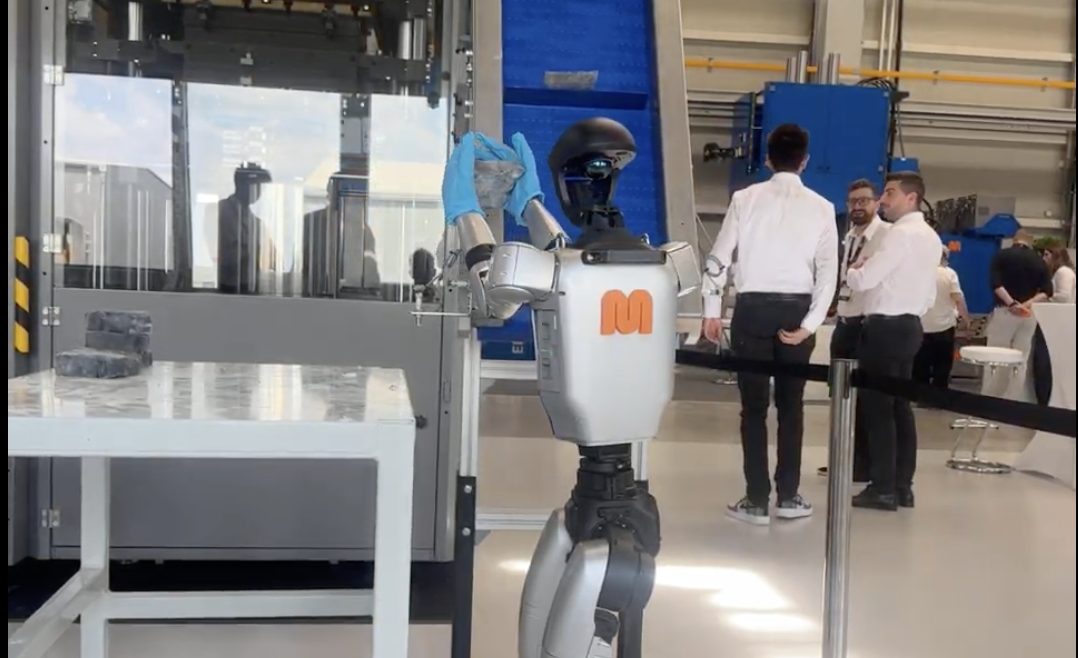
It reaches for the silicone block, lifts it carefully and moves toward the injection molding machine. Gently, it places the block into the designated slot. It then activates a sensor. The conveyor belt automatically advances to the next position, ready for another block. The robot is already reaching for the next one.
Pilot project with Maplan and Terra Robotics
For the visitors at our joint event with Maplan and Terra Robotics, it was an impressive demonstration. A humanoid robot operating an industrial silicone injection molding machine was exactly what they had come to see.
But I found myself thinking about something entirely different.
While everyone was watching the robot, I was watching the machine.
Because in that moment I realized something.
The robot hadn't adapted to the machine.
The machine had started adapting to the robot.
That was the real insight of the day.
Of course, the robot had to learn how to pick up the silicone blocks and place them accurately. That was the visible challenge. But the more interesting work happened behind the scenes, where we gradually adapted the entire process to the robot.
Humans and humanoid robots simply work differently. Today, an operator places several silicone blocks onto the conveyor belt, walks to the other side of the machine and starts the next production step. A humanoid robot would never choose that sequence. It naturally works in a continuous flow: pick, place, activate the sensor, move to the next block. That seemingly small difference changes the entire material flow.
To make this possible, we had to rethink parts of the production process. Additional sensors allow the machine to detect when the next position is ready. A simple mechanical guide helps the robot place the silicone blocks more reliably. We even discussed the shape and handling of the material itself because they directly influence the reliability of automation.
None of these changes is spectacular on its own.
Together, however, they tell a much bigger story.
"Today, we spend a lot of time discussing when humanoid robots will become productive in manufacturing. But perhaps we are asking the wrong question."
The more interesting question is:
How humanoid-ready are our machines and factories?
As humanoid robots gradually enter manufacturing, logistics and assembly, it won't just be the robots that evolve. Machines, production lines and workflows will evolve as well. Interfaces will become smarter. Sensors will become more important. Processes will become more continuous. Even products themselves may change so they can be handled more efficiently by robots.
This is exactly why I believe pilot projects like this are so valuable. They don't just demonstrate what humanoid robots are already capable of today. They reveal the changes companies should start making now if they want to deploy this technology successfully in the future.
When I watched the robot that day, I initially thought we were teaching it how to work with an existing machine.
By the end of the project, I had come to a different conclusion.
Perhaps the real transformation begins when machines learn to work with robots.
Curious what this could look like in your factory?
Together with our partners, we help companies identify meaningful use cases for humanoid robotics and turn them into real-world pilot projects. If you'd like to learn more about how we implemented this project at Maplan — or explore what humanoid robotics could mean for your production environment — I'd love to continue the conversation.