Imagine standing in front of your washing machine. Your workout clothes are soaked with sweat, and you only have thirty minutes before you need to leave. You want them to be as clean as possible but also dry enough to put straight back into your closet. Today, you would have to choose between predefined programs. Sports mode? Quick wash? Eco? As always, the user has to decide which compromise makes the most sense.
But what if the interaction looked completely different?
Instead of selecting a program, you simply say:
"I have sweaty workout clothes and only thirty minutes. I want them as clean as possible and dry enough to put back into my closet."
The washing machine responds:
"I can optimize the wash cycle for your goal. If I shorten the soaking phase and use that time for a longer, gentle spin cycle, your clothes will come out significantly drier. However, the cleaning performance will slightly decrease. Would you like me to make that trade-off, or should I prioritize maximum cleaning instead?"
You confirm.
The machine starts.
It didn't choose the Sports program.
It didn't choose the Quick Wash program.
It created an entirely new program for your specific situation.
That simple scenario has stayed with me ever since our China Innovation discussions.
For the past two years, the AI conversation has been dominated by foundation models. We compare OpenAI, Anthropic, Google and Meta. We debate benchmarks, reasoning capabilities and context windows. We ask which model will ultimately win.
But after reflecting on what I saw and heard in China, I started wondering whether we are looking at the wrong battlefield.
What if the next AI race isn't about platforms at all?
What if it's about distribution?
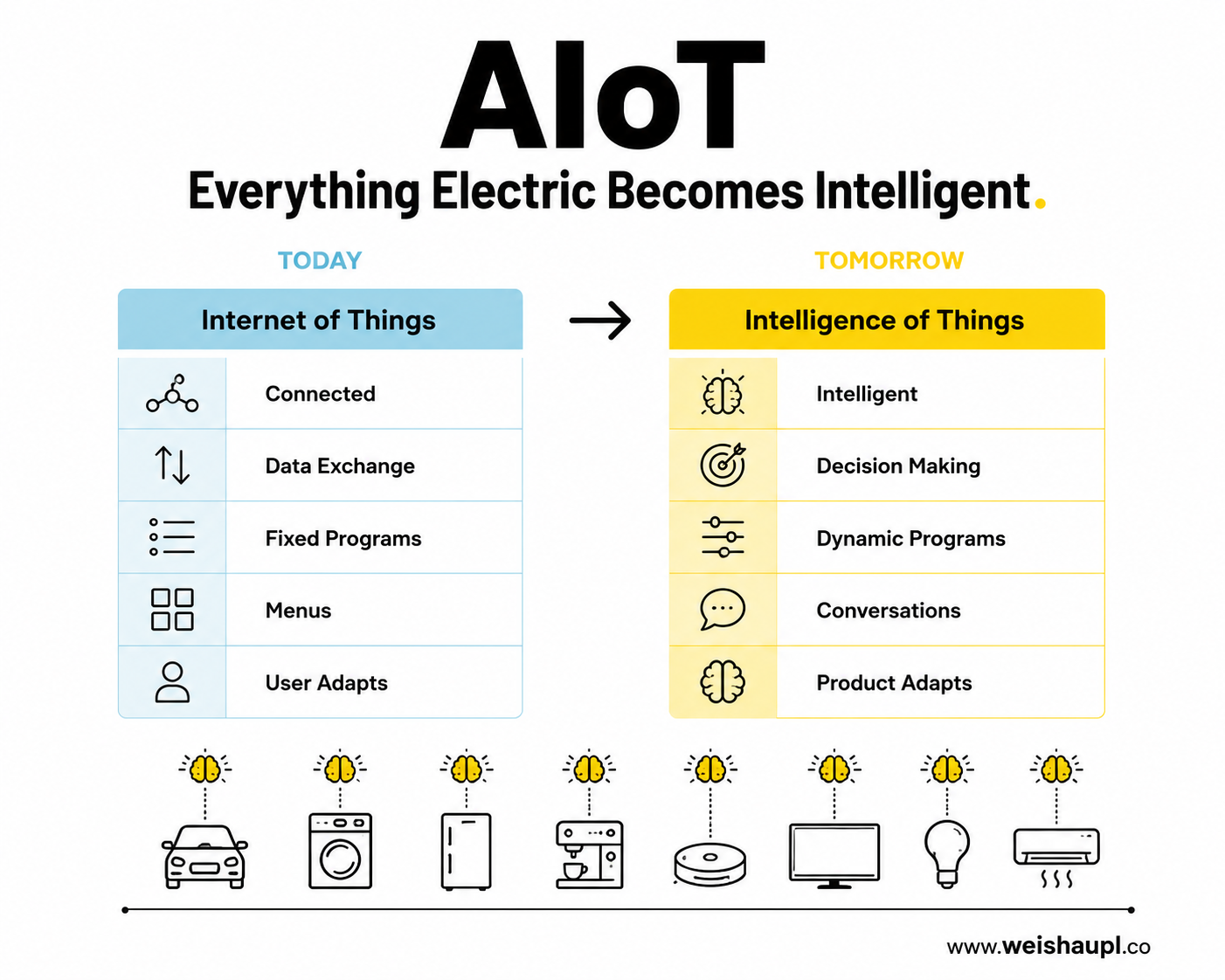
There is already a term for this development: AIoT – Artificial Intelligence of Things. Personally, I think Intelligence of Things may describe the idea even better. Because in the end, it isn't about devices containing AI. It's about devices becoming intelligent.
The Internet of Things promised a world of connected products. Devices would exchange data, communicate with each other and create smarter ecosystems. Yet connectivity alone only creates limited value. A washing machine that sends a notification to my phone when the cycle is finished is convenient, but it doesn't fundamentally change the way I interact with it.
A washing machine that understands my intent, asks follow-up questions, weighs competing priorities and dynamically creates its own wash cycle is something entirely different. It no longer asks me to adapt to predefined functionality. Instead, the product adapts to me.
"Today we navigate menus and choose from fixed functions. Tomorrow we simply describe the outcome we want – and the product figures out the best way to achieve it."
The difference may sound subtle, but it changes everything. Today we navigate menus and choose from fixed functions. Tomorrow we simply describe the outcome we want, and the product figures out the best way to achieve it. The user interface of the future may no longer consist of buttons and settings. It may consist of conversations.
One company that caught my attention is Haier. The Chinese appliance manufacturer is rapidly expanding AI capabilities across its smart home ecosystem and positioning artificial intelligence as a core capability rather than a premium add-on. AI is increasingly becoming part of the product experience itself.
That observation made me stop and think.
Because this is no longer just about smarter washing machines or refrigerators.
It's about a future where intelligence becomes a default property of products.
And that raises an interesting strategic question.
If AI is embedded directly into millions of appliances, distribution no longer happens through an app store or a chatbot interface.
It happens through the products people already buy.
In the West, we often assume the AI race will be won by the company with the smartest model. We compare ChatGPT, Claude, Gemini and other foundation models as if consumers will consciously choose between them forever.
But what if they don't?
What if the AI model is already built into your washing machine, your refrigerator, your television, your robot vacuum or your car? What if users never actively choose an AI platform because they simply buy a better product?
In that world, the competitive advantage is no longer limited to building the best model.
It may also depend on embedding intelligence into the largest number of everyday products.
Perhaps this is where China's manufacturing ecosystem becomes strategically important. If millions of connected products ship with locally developed AI already integrated, the battle for AI adoption could look very different from the platform race we are discussing today.
Of course, this is only one possible future.
But I believe it is one worth paying attention to.
The first wave of AI made software intelligent.
The next wave may make products intelligent.
And perhaps the biggest AI competition of the next decade won't be fought inside chat windows.
It may be fought inside the products we use every single day.
Curious how AIoT is reshaping industries and products? Take a look at the keynote.